Say good bye to cowboy boots, and hello to hoop skirts and mint juleps, as we head into Antebellum South to visit the Plantation area of the Mississippi River. Natchitoches, a town along the road whose name alone would be enough to make me want to visit, was passed by on a course for what was once some 400 plantations along River Road, with hopes of returning again to that area of British influence during the same period. As we did heading to New Orleans, I once again marveled at the Atchafalaya Heritage Area, and the massive swamp and road that crosses it. The Basin is the nation’s largest river swamp with almost one million acres of bottomland hardwoods, swamps, bayous, and backwater lakes, and it is beautiful! And not a spot to take a photo, at least from the road.

Only a handful of the plantations remain, and we decided upon two to visit, which proved a wonderful contrast in style, and extremely interesting and informative. The first plantation we visited was actually a working home, with the owners time there spent doing the business of the cane fields, and then spending “the season” of January through March, in their town home in New Orleans. The people who lived in The Laura, named for one of the residents who left tremendous documentation about life there, spoke only French, and the house was multi colored, reflecting that, while houses that were painted white signified that the inhabitants spoke English.

This is the land of the Cajuns, who trace their roots to the influx during hostilities in what is now the Maritimes. Stories of the families, the sugar cane businesses, and the slaves were thorough and well presented in this modest home with its outbuildings and gardens, and a wealth of the original belongings.
 |
| The map shows the original plantations all along the river. |
 |
| These basement ceiling markings corresponded to the same in the upper and attic floors so the slaves would know how to construct the "prefab" house! |
 This woman lived in the house until she was in her 90's!
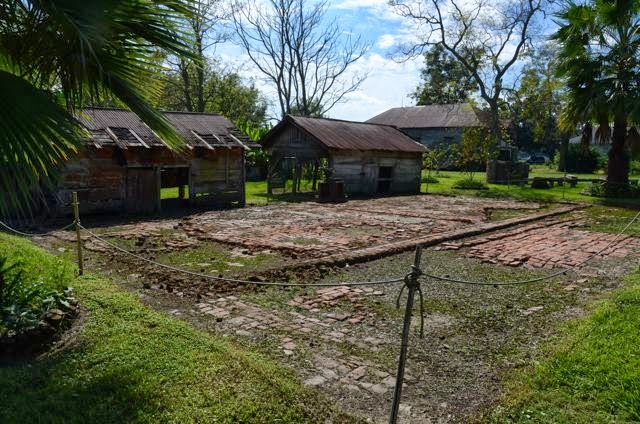 |
| The bricks in front of the chicken coups were the flooring to the original kitchen house, which burned down. |
 |
| One of the original slave houses, still intact. People lived in these until 1973, not knowing anything different. When they finally did move, it was just down the block. |
Oak Alley, in contrast, was far more opulent, and the tour guides were in period dress, complete with hoop skirts. A line of 28 majestic 300 year old Live Oak trees, planted by an unknown person years before the house was constructed, create a canopied alley leading to the house, mimicked by the 28 columns on each side of the square Gothic Revival/Caribbean style home, hence the name.

The house has high ceilings, large windows, a large entry hall running front to back, and a deck surrounding the upper floor provides a lovely view of the trees and huge estate, and the river, before the barriers were constructed. This is the estate where slave tales were recorded and then told about a mischievous Brer Rabbit, here known as Compair Lapin in Creole French.


 The young woman who owned the house loved to throw large dinner parties, and this table could seat 18. The contraption over the table would be slowly waved by a slave by using the attached rope. Hard enough to cool and keep the flies away, but not so hard as to blow out the candles! All evening!
  |
| the children's room |


Despite the grandeur, the slave quarters have been rebuilt as testament to the times, and signs document the story.


It occurred to me while in the Southwest, that we could almost be in a foreign country, with the influence of the pueblo Indians, and the art and dress being so vastly different from what we are used to in the rest of the country. And the southern part of the US bears so much of our history, with the Spanish settlement and influences, Texas once being an entire nation in itself, the Civil War, Civil Rights, Southern Belles and Plantations, and on and on! Funny.....history was so boring when I was in school, but to see it, is to be fascinated!

Wish we were there! Looks like a nice day.
ReplyDeleteIt was lovely, Judy, and you would have enjoyed it. Wish you were there, too!
DeleteLove the history that you tell! Thank you
ReplyDeleteNice to know you enjoy it, Susan! Thank YOU! :-)
Delete